Australia Post: prices, reviews and comments
PO Box and Stamp Prices
| Year | PO box price (small size, standard location) |
Stamp price (regular letter) |
|---|---|---|
| 2024 | $159 | $1.50 |
| 2023 | $153 | $1.20 |
| 2022 | $144 | $1.10 |
| 2021 | $141 | $1.10 |
| 2020 | $139 | $1.10 |
| 2019 | $135 | $1 |
| 2018 | $132 | $1 |
| 2017 | $129 | $1 |
| 2016 | $126 | $1* |
| 2015 | $120 | 70¢ |
| 2014 | $112 | 70¢ |
| 2013 | $104 | 60¢ |
| 2012 | $98 | 60¢ |
| 2011 | $91 | 60¢ |
| 2010 | $84.50 | 60¢ |
| 2009 | $80 | 55¢ |
| 2008 | $75 | 55¢ |
| 2007 | $70 | 50¢ |
| 2006 | $60 | 50¢ |
| 2005 | $56 | 50¢ |
| 2004 | $55 | 50¢ |
* From 2016 onward mail delivery will take about 2 days longer than before, unless additional priority label is purchased.
AusPost year by year: a sad decline of a great service
2004—2014
Australia Post put the prices of its post office boxes up, again. In 2014, the cost of a small PO box became $112. In 2009, the price of the same box was $80, so in five years Australia Post increased the cost by 40%. Average yearly inflation rate in Australia during the same 5-year period was about 2.75%, which results in 13.75% inflation for those 5 years. Over the past 10 years, considering that the cost of a small PO box was $55 in 2004, Australia Post increased PO box prices by nearly 104%. Inflation in Australia over the last ten years was around 27%. Which means that Australia Post increased its post office box prices 77% above the inflation rate.
Normally, higher prices are justified by higher running costs, implementation of new expensive technologies or increased cost of maintenance. However, Australian PO boxes haven't changed for decades: they are still exactly the same black boxes with small doors and awkwardly large keys — so, besides the inflation, the running cost and maintenance should not be that different to what it was before. All the new services like email alerts or SMS notifications about the presence/absence of new mail in the box are available at a substantial extra cost ($55 and $89 respectively) on top of the box price, and thus cannot be used as an excuse for the price rise.
Nevertheless, Australia Post is blaming the price-hike on the mounting costs related to raw materials, delivery, transport and energy despite the fact that people who rent PO boxes are actually saving Australia Post money by reducing the street mail deliveries; the futile transportation of parcels back to post offices for later collection by the addressee when street address delivery fails; the cost of subcontractors for door-to-door parcel deliveries; the fuel costs; and by eliminating complaints about misdelivered letters or parcels that were stolen or damaged by rain, insects or sun when left on the premises. It also helps the Post to maintain a reliable service, because any letter placed in a wrong PO box can be returned immediately by simply pushing it to the back of the box so it pokes out a bit and attracts the attention of the sorting person. Whereas with the street delivery, those letters are often left on the top of the street mail box to be destroyed by rain or blown away by wind, because not every person has enough time or civic consciousness to take the misdelivered letter to the right address (of it is nearby) or to a post box for a safe return.
Therefore, by deterring PO boxes customers, Australia Post actually increases its costs rather than achieves higher revenue. When questioned about the yearly increase of post office box rental renewals far in excess of the annual Australian inflation rate, Australia's Post reply was:
We understand your concern around our PO Box prices, price rises are never popular. We need to ensure that our business is self-sustaining like any other commercial enterprise and this price rise was required. We remain committed to continuously improving our products and services and providing them to our customers at competitive prices.
Australia Post
Committed to continuously improving our products and services
? — Did PO Box service improve by 77% during past 10 years? Nope. The boxes look, feel and work in exactly same way as in 2004, 1994 or 1984.
At completive prices
? — By competing with whom?
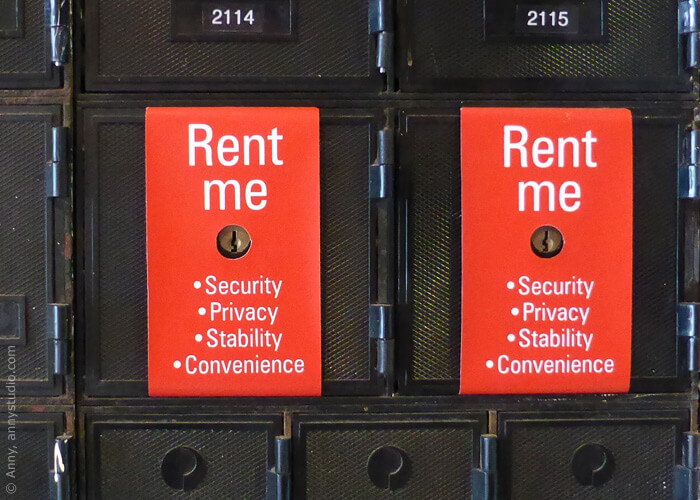
Price increases may be necessary, but if they far outstrip the annual inflation without any valid reason or explanation, consumers will vote with their feet. No wonder that every March, when PO box rents are due, the red-coloured “Rent Me” signs are plastered all over the vacant boxes. Australia Post seems to be pricing itself out of the market.
Where do the profits go?
According to some sources, LPOs (Licensed Post Offices) — the local post offices and the employees we deal with on everyday basis — do not receive all the profits. Worse still: the payments to Licensees have been failing to keep pace with the imbedded cost of the provision of services. Which may mean that not only the prices are way higher than they should have been, but the extra profits are not actually going to the people who do the hard work. Post offices are given flat rate fees for delivering parcels, and basically discouraged by Australia Post management from servicing PO boxes.
The delivery process includes scanning each parcel in, placing a card into the PO box if the parcel doesn't fit the box, storing the parcel, serving the customer when they come to collect the parcel, scanning the parcel out, and, if required, obtaining the signature. The sorting must be completed by 9 am every day, and, given the increasing volume of parcels due to the popularity of online shopping, may require additional employees, yet the payment is the same flat amount, regardless of the cost the customers pay for parcel postage and for PO boxes, both of which Australia Post continues to increase without proportional benefit to the Licensees. The so-called fee for delivery to a business point does not account for the number of parcels to be delivered; that is, LPO receive the same payment for delivering one parcel per hundred PO boxes or for delivering five parcels to each of those boxes.
As a result of the increasing cost, the number of PO boxes leased at LPOs steadily decline. The Licensees are losing their customers and income while Australia Post is increasing and pocketing the fees. In addition, the costs and amount of work LPOs have to do to deliver mail to street address is greater than if the customer would have kept renting a PO box.
One would wonder if this short-sighted mismanagement within Australia Post is deliberate, and the aim is to increase the Post's short-term profits to make it easier to sell the whole system in the future? The very system that belongs to all Australians, is vital to the existence of the country, and should be a well-functioning entity that provides impeccable service. After all, while many types of communication now moved online, the post still has to deliver important paper documents, such as passports. And that's where any failure in delivery may have disastrous consequences.
Speaking of increases, according to Crikey, in 2013, Australia Post workers received a pay rise of 1.5%, while its CEO Ahmed Fahour, already one of Australia's highest-paid executives, received a pay increase of 66%, which brought his salary to an unprecedented $4.8 million a year!
2015
This year, Australian Post attempted to create an allusion that something will actually change, that the PObox-renting customers will get a bit more for their money. The PO box renewal notice boasted a colourful promise: PO Box notifications coming soon. We'll soon provide you with electronic notifications to let you know when you have mail awaiting collection. Simply update or confirm your details and we'll be in touch to let you know how to receive notifications
.
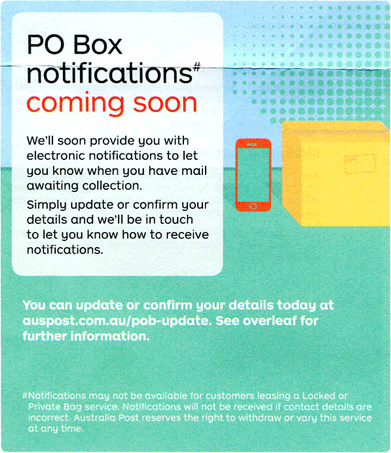
It sounded good, but a phone call to AusPost revealed that the notifications will be provided through the Australian Post's MyPOST Digital Mailbox account, which is their online service for receiving and storing the person's bills and important documents, as well as the current AusPost CEO's attempt to look young, hip and technologey. The notifications will not be delivered to the customer's mobile phone or e-mail address, as many were lead to think by the renewal notice asking the customers to update their phone number and e-mail address. If for whatever reason the customer doesn't want to sign up for yet another online myAccount, on top MyGov, MyHealth, MyTax, MySuper..., or doesn't want to trust the important personal documents to Australia Post, or is an older person who is not comfortable using computers — tough! No notifications for them. There was nothing about the need to sign up for the Digital Mailbox in the ad or anywhere else on the renewal, not even on austpost.com.au website. A misleading move, akin another Australia Post offer: to mitigate the impact of the upcoming postage stamp price rise from 70c to $1 that may heavily affect older people who are unable to use online communications and rely on paper letters, AusPost offered freezing the cost of stamps for this category of people. To receive the concession stamps, the person must signup for the online(!) MyPost Concession Account, which requires an e-mail address.
2016
In 2016 AusPost received a lot of criticism for inventing a way to give Australians a slower service for a higher price: the stamp price rose to $1, and, at the same time, the standard letter delivery time was made about 2 days longer than before. One can only hope that the slower speeds will lead to a more accurate mail sorting and delivery.
The PO box renewal letter came with the exactly same announcement as the previous year: Collection Notifications coming soon
.

The PO Box application form still contains the misleading: we can send you an email and / or SMS notification when you have an item waiting to be collected
. Though AusPost finally mentioned in its Post Office Box Service Terms and Conditions that, in order to eventually get the notifications, the customers must open a MyPost Digital Mailbox, the online service Australia Post keeps actively pushing after losing its ability to deliver real mail properly and promptly. The so-called email notification will be, in fact, a message sent to the MyPost Digital Mailbox, and the so-called SMS is nothing more than a push notification through the MyPost app, which has to be tied to a MyPost Digital Mailbox and has huge limitations on what phones and mobile systems it works with. All in all: useless, unnecessarily complicated, privacy-invading, and not even there yet.
It may be wise not to register for their Digital Mailbox or give AusPost your email address, not only to safeguard your privacy, but also to avoid getting electronic spam in addition to the paper spam they keep shoving into PO boxes despite the customer opting out of spam on the application form. The clause on the renewal notice your personal information may be used to provide you with information about our products and services, as well as information from other businesses (including unaddressed mail) directly to your PO Box
clearly states: there will be junk mail. To open Australia Post Digital Mailbox, the customer has to have an email address; so why not receive the bills directly to the personal email address, without dragging a dubious third party into it and entrusting that third party with your security, online safety, personal and banking details?
AusPost also suddenly started demanding to have the customer's date of birth in their system, otherwise they would be unable to provide this service
. How they have been able to provide exactly same PO boxes with a more reliable, fast and affordable delivery without excessive privacy intrusion up until now, is a mystery. It looks more like an excuse to grab as much personal data as possible instead of actually providing a good service.
2017
According to AusPost brochure, they are promising 24/7 parcel collection. That's if your post office has that service available, as the fine print at the very bottom of the reverse side of the brochure warns. Good idea, if it works and does not require registering somewhere online and handing over yet more personal information.
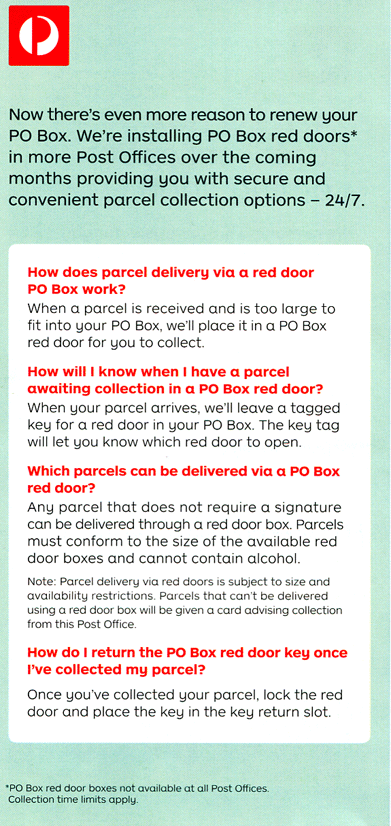
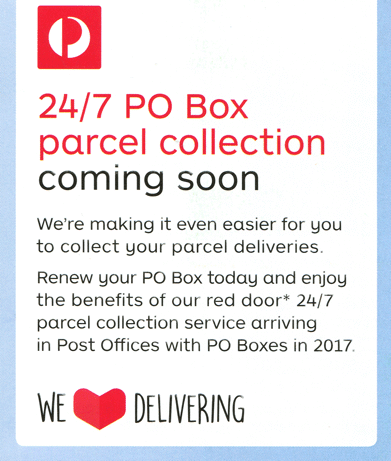
Other than that, the past year seems to have been pretty uneventful: the stamps are still $1 (wow!), the delivery is slower, the letters are often left sticking out of the street mailbox, the usual PO Box price rise (although, the increment is smaller than in recent years), signing up for a MyPost account is suggested at every opportunity AusPost gets (they must be desperate to get the subscriber numbers up), and the “free notifications” are still only available to those who signed up for MyPost.
Signing up for a MyPost account? Think twice...
AusPost seem to be pushing MyPost accounts at every turn and opportunity and promising countless benefits. However, a closer look at MyPost terms and conditions and AusPost Privacy Policy (which unfortunately very few read before signing up) reveals what MyPost really is. Here are just a few lines that would make any safety- or privacy-conscious person say a resounding ‘no’:
You grant to us an irrevocable, perpetual, non-exclusive, worldwide, royalty-free licence to use, reproduce, modify, adapt and communicate the Data (and all data and information comprised in the Data), and to sublicense third parties to do those things, to enable us to: (a) operate the Website and provide the Services; and (b) perform statistical and other analyses that are relevant to our business purposes.
You acknowledge and agree that ... we make no representations, warranties or guarantees in relation to the integrity of the Data or length of time the Data will be retained by us.
We may transfer personal information to countries outside Australia. Australia Post uses service providers in other countries as follows: Japan, Singapore, United Kingdom, United States of America, France, New Zealand, India and the Philippines.
We shall not be liable to you or to any other person (whether in contract, tort or otherwise) for any loss or damage suffered, or that may be suffered, as a result of any act or omission, whether negligent or otherwise, by or on behalf of Australia Post in relation to your MyPost Account
MyPost Terms and Conditions and AusPost Privacy Policy
The aforementioned Data includes such information as your name, address, email, phone number and government-issued forms of identity used for identity checks. AusPost is basically saying that you must agree that they will use your personal information as they see fit; share it with whomever they choose, within Australia and overseas; keep it for as long as they like, even after you closed all accounts with them; and they are not responsible for any consequences or what happens to your identity information in the future. And as the reader feedback indicates, using MyPost and Parcel Lockers not only means giving away one's personal data, but also creates a risk to be put under surveillance for not good reason.
Another thing to bear in mind: MyPost account cannot be closed and deleted online. MyPost is quick to grab your personal data online, but to terminate MyPost account you have to call AusPost on 131318 (according to MyPost account Terms of Use, Termination section). And even then, MyPost Terms and Conditions say they may retain a copy of your data to comply with our regulatory obligations
. So it is best to avoid creating the account in the first place, and if you were tricked into creating it and do not want it, delete it and also lodge a complaint with AusPost demanding that they should add a quick and easy way to delete these accounts online. They didn't require the person to call to create the account, so they shouldn't be using phone call obstacles for deleting it.
2018
Australia Post now demands email address as mandatory information on the new application for a PO Box (it was optional before). Why? They give no reasonable explanation except for the usual We will be unable to process your application if you do not provide the information requested
. They somehow have been able to process the same application for the same boxes for decades without this information, but now suddenly they can't.
They also appear to be harvesting email addresses from parcels where the sender added the address to the sending details, and immediately emailing out some survey. The survey does have an opt-out link, but even by opting out, AusPost sees the customer action that validates the address, which they then can store in their database for an unknown period of time and fon an unknown purpose.
2019
Finally, a positive change in some post offices, promised a couple of years ago, and done the good old-fashioned way that does not require signing up for yet another online account or giving away yet more personal data.
Some post offices now installed “red door” parcel delivery boxes that can be used by PObox-renting customers to collect parcels 24/7. Great system, invented hundreds of years ago and now finally reintroduced in AusPost. Easy to use, always works, doesn't rely on some online system, doesn't even need electricity to operate. A parcel, if it fits and doesn't require a signature, is placed in one of the red boxes, a metal key or a key card is placed in the PO box, and the customer simply needs to return the key trough the slot in the wall after they collected their parcel.
Note: do not confuse these mechanical key-locked “red door” boxes with “24/7 parcel lockers”, which require a MyPost account.
2020
According to notes and warnings on the AusPost website, coronavirus impacted their network and caused delivery delays. Understandably, more people were shopping online during the lockdown, when real shops were closed, thus creating an increase in parcel numbers. Many parcels took much longer to arrive, some were lost...
Unfortunately, to lodge the late or missing item enquiry, AusPost demands that the customer creates a MyPost account. It uses the trap that became very common nowadays: on the first page, it asks the person to fill a lengthy form without any indication that they need a MyPost account. Then on the following page it says to submit your request, please login or sign up for MyPost account
. AusPost calculated that after the person spent time and effort filling the first page, they are less likely to turn away and refuse to sign up. An annoying trick for harvesting personal data and increasing subscriber numbers.
At the moment, there is a partial solution: use the complaint page and select the missing item option there. In this case, so far, you can send your enquiry without creating a MyPost account, thus giving away less personal information than is demanded in the Missing Item form. However, judging by the reader's feedback, trying to contact AusPost about a lost parcel is a futile exercise. If the item is still somewhere on it's way, it will eventually get to the recipient, and no form-filling will speed it up. And if the item has been truly lost, then you are simply giving them your personal data for zero benefit.
Like you, I am a PO Box renter, and similarly appalled by the unreasonable cost and significant annual price increases. As you point out, the technology has remained unchanged for many decades, so there is clearly no "R&D" to be amortised. Box layouts challenge both those of short stature, and most particularly those unfortunate enough to have one on the bottom rows, who are forced to kneel. As there are "establishment" fees (and additional fees for keys), it is reasonable to presume that the bulk of the "leasing" fees are related to the costs of mail distribution.
I have surveyed my Local PO, which has approximately 700 boxes (a mix of Small, Medium & A4), with all but 2 in use.
In 2014, even with pay-on-time rates the revenue aggregates to just shy of $86 000. I am advised that the time spent distributing the mail items in to these boxes is between 2–2½ person hours per day. At $20 per hour (plus 30% on costs) and for 250 working days per year, the actual cost of servicing the boxes is around $14 650. (This is a generous estimate of labour costs, and which are probably significantly less, especially in high volume facilities where staff performing this function will likely be on lower rates, and with lower on costs.)
This represents at least a 600% differential between cost and revenue!
It is well documented that the volume of physical mail continues to decline significantly, so the labour costs to service PO boxes (even after annual CPI rises) are almost certainly actually reducing. And, as the use of PO Boxes reduces Australia Post's costs for street delivery, there ought to be a rebate factored in to PO Box rental to reflect this.
As a general principle, the cost to the client for a service should not appreciably exceed the actual cost of its provision. In the absence of a plausible explanation of the cost of provision of this service, the sustained annual price increases and their magnitude, this simply amounts to gouging.
Anonymous, 14 March 2014
We miss the postal service that was once fast and trustworthy. Perhaps it was luck, but until 2010 our household haven't had a single letter or parcel misdelivered, lost, or unexplainably delayed.
Since 2010, numerous parcels and letters have been lost, including a registered express letter with important documents. Sometimes the postal tracking displays totally incorrect information rendering the tracking number useless. Several letters definitely correctly addressed to our PO Box have been returned by AusPost to sender without anyone in the post office knowing why and by whom. Wasn't one of the points of having a PO Box to get a more reliable mail delivery, not less?
Four or five parcels took several months to arrive from overseas, reaching Australia a few days after they were sent and then either vanishing from the tracking record or displaying "in transit" for months. We also had an issue with the postie (or posties, as they change very frequently) dropping letters on the ground in front of our letterbox, or leaving the mail sticking to the street out of our very spacious letterbox. We also frequently have other people's mail put into our box, which we either deliver to the correct address by hand, if it is not too far, or send back. We hope that other people are kind enough to the same with our mail should it be misdelivered to their addresses.
Why is this suddenly happening? If the volume of mail decreased drastically, shouldn't the chance of an error decrease too? Sadly, almost everybody now has at least one story along these lines.
Anonymous, 27 February 2016
I have a MyPost account, which I had to create to be able to collect my parcels from parcel lockers. I study and work long hours, so it is virtually impossible for me to be at home for a delivery by a postman. So it looked like receiving parcels to lockers close to my work or university was a good option. Until I suddenly received this nasty email from AusPost:
"Australia Post values the security of our customers and delivery services. We monitor the usage of these services carefully. As part of this security monitoring, we wish to advise you that the MyPost account created using this email address matches patterns that have been identified as being potentially at risk of misuse. As part of our responsibility to help protect our communities, Australia Post may work with Australian law enforcement authorities to monitor deliveries to the addresses linked to this account."
Shocked and confused, I tried to contact Australia Post for an explanation. Their reply was of course just some boilerplate text. So I did my own research and found that some of those 'patterns' include: having one address as a registered street address in MyPost account and several others as collect addresses; changing email address associated with MyPost account; using an email address on a privacy-respecting service like ProtonMail. The situation is absolutely ridiculous! I don't want AusPost keeping a surveillance file on me! So now I'm closing the account and hope to wipe out as much of my data from their system as possible.
Anonymous, 2 August 2018
I rent a P.O. Box in my name. My daughter uses it as well, getting parcels and letters sent in her married name. She has just been told this is not allowed. Why?
Anonymous, Australia, 18 January 2021
Why? Good question! Surely Australia Post can deliver items to different people at the same address. They do that just fine when it is a house or other premises. Most likely they said that to your daughter for one or both of the following reasons. 1 Australia Post wants to make more money by compelling your daughter to open another P.O. box in her own name. 2 Australia Post wants to put your daughter down as an additional authorised user of your P.O. box and thus obtain more of her personal data.
We live in a world of mass surveillance, data retention and customer profiling. Every government organisation wants to get maximum personal data on each citizen to keep tabs on everyone. Each commercial organisation wants to get maximum personal data for upping the effect of their marketing tricks. Given the position of Australia Post as a semi-government and semi-privatised beast, it is probably doing both.
Anonymous, 22 January 2021
Australia Post is becoming next to useless, or even dangerously untrustworthy service to use.
During the past 12 months I sent 7 letters and parcels from different post offices, all addressed within Australia, all with tracking numbers. Two of the seven gone missing!
AusPost tracking page just says "We've got it! Received by Australia Post" or "Item processed at facility (Someplace NSW)" and then things get stuck at that. The parcel or letter just vanishes into thin air. Trying to contact AusPost and start an investigation is a waste of time and a goodbye to the privacy of your personal data. All they do is tell you to sign up for myPost account, then they collect all your personal data, tell you "sorry we could not locate your item", and start sending you their corporate spam. You can't even close that unwanted myPost account without calling them and wasting more time on the phone with them.
The missing letter contained documents. The missing parcel contained an irreplaceable sentimental present for a family member, which could not be given in person due to state borders closed by the covid pandemic.
Is there a way anymore in this country to send anything important without it getting lost, or without spending weeks staring at the tracking page and stressing out worrying if it ever reaches its destination?
Anonymous, 16 March 2021
Reply to Anonymous, Australia, 18 January 2021: This is wrong. As long as the mail is addressed correctly to the PO Box address and it is cleared out often enough to prevent "overflow", it can be used by anyone you allow. You can get an extra key for them from the post office. Contact Australia Post if this continues, it is against the policy.
Anonymous, 16 April 2021
I know why Personal PO Boxes are in decline across NSW. It is because of the current rental problem. See one needs to be employed today to be able to get a new rental lease. For those that have lost their jobs during covid and are living off their savings (not government payments) until the economy gets back up and running, they are unable to gain new rental accommodation. Without having a rental lease, and bills that go along with a property, one does not have the documentation to get a Personal PO Box. Many of these people have had to share rent and thus their name is not formally on any utility bills. The share rental situation in Sydney is really bad. Even worse, is the room share market that is skewed to exploiting international visitors. They are paying $200 for a bed in a shared room, a local pays $200+ for their own room with a shared bathroom. I've spent the past 20 years renting and paying my rent upfront in advance, I've recently become unemployed due to covid. I have the funds to pay out a new lease but because I'm technically currently not employed I cannot get approval for a new rental lease. My financial advisor said get a PO BOX if you have to move around a bit until re-employment and new lease, he didn't realise that a person can't qualify for one if they don't have bills. Our system of everything is just becoming to damn hard to navigate and function within.
Bee, 9 December 2021
Unfortunately, most systems, including the postal system, have become obsessed with personal data and identity checks under various pretexts (national security/anti-terrorism/money laundering/child abuse/covid/etc). Even though PO box fees are paid in advance, and there is no chance of customers absconding without paying, Australia Post still wants to collect full personal details and verify the person's identity for a mere PO box as if it were a bank account.
On the current "Applying for a PO Box (personal use)" form, Australia Post says: "Complete the application form and take it to a participating Post Office along with your Driver's Licence to confirm your name, your address and signature. If you don't have a Driver's Licence you will need to provide two forms of identification – one from each of the categories below.
To confirm your name and signature:
- Passport
- Credit Card
- EFTPOS Card
- Government Concession Card
To confirm your residential address:
- Utilities account (gas, electricity, telephone or water bill)
- Rate notice
- Bank statement"
For a person who has neither a driver's licence, nor a passport, nor utility bills, getting a PO box would only be possible if that person has a bank account and can produce a bank card and a bank statement.
Great job on the research into this topic. I have always known Aus Post sucked but never really knew how hard. 3 votes on for this article.
Disgruntled Customer, 13 March 2022
Byuer beware! Auspost requires at least one phone number in their po box application. So if you don't have a number or are not prepared to give your personal details to a telco where hackers nick it later, you can't have a po box either.
Anonymous, 27 September 2022
Good point. It is indeed a mystery why and what for Australia Post needs each PO box customer's phone number on such a compulsory basis. They already have the person's home address and, naturally, the PO box address. They are the post. Why can't they contact their customers by post? Or are they so distrustful of their own services?
Besides, aren't the main reasons for renting a PO box to have privacy and to communicate by post instead of email/phone?
Just got my letter for renewal. For a small box with Plus attached it's $174 now in Adelaide. $153 for the box now. The plus option is really handy and a great service now couriers actually go inside, but it does seem to be increasing more than inflation these past few years.
Anonymous, 7 February 2023
Just got my letter for renewal. For a small box it's $153 now in Brisbane. Not going to renew because it's $153 that I could pocket myself per year.
Brock A, 11 February 2023
It puzzles me every year: why the PO Box renewal never has a BPAY option? Why can't I pay for it quickly and securely through my banking? For paying online, it offers only PayPal, Post Billpay and Auspost App.
PayPal is not even an option for me because it means giving inordinate quantities of my personal data to an American company that I have zero trust in. I closed my PayPal account ages ago after they swindled me and then tried to extract multiple photo ID and more personal info from me under vague promises to look into the problem. Exactly what scammers would do. So I won't go anywhere near PayPal ever again. And I have no wish to open yet another unnecessary account with Australia Post or its app.
All my other bills have a BPAY option, but not the PO Box bill. Why??
Anonymous, 19 February 2023
Presumably, because AusPost wants people to use their Post Billpay system or their app rather than BPAY.
Post Billpay could be an acceptable option if it didn't require the payee's email address, and didn't state in its Terms & Conditions , where they basically absolve themselves of the responsibility for the safety and security of their system.
However, there is still a wonderfully cute and old-fashioned option for pay by mail/cheque. And an option to pay in-store.
Paying in person, at the post office, may be the best way. Perhaps not always the most convenient, but definitely the most secure and the least intrusive.
I live in remote NSW and the residents of my town have no choice but to have a PO Box as there is no home mail delivery. It is annoying to have to find the money required every year when one is on a pension.
Mischie, 11 April 2023
It seems, Australia Post offers reduced rate for PO boxes in the areas with no home delivery. But, of course, it is still money. And, according to AusPost conditions, it
It seems that reliable postal service is now a thing of the past for Australians. It used to be a send-and-done feeling. Now it is send-and-begin-to-worry feeling every time. We have already given up on sending anything of any importance via ordinary mail and always use registered post for that. But even the registered service has now been wrecked. For us it's the third time already when a registered post letter ends up at 'in transit' stage in AusPost tracking and never progresses beyond that. Then after a few months the tracking number just vanishes. This whole system is utterly unreliable and useless. We have no way of knowing whether such registered letter has ever been delivered. And the so-called "late or missing item enquiry" process that Australia Post offers is even worse than useless. It makes you give them your personal and contact details, and then tells the same thing: the letter could not be found. This time we can't even be bothered filing those forms. If we can't trust Australia Post with registered letters, we shouldn't trust them with our personal information.
Anonymous, 20 September 2023
I am so glad that I have always lived by the same rule as you mention in several places on this site: the best way to protect yourself from scams is to never share your personal information with anyone who doesn't truly need it.
On several occasions Australia Post asked me for my phone number and/or email address. I have always said NO! And now I am very glad that I have always refused.
After everyone's contact details were stolen by hackers from Optus and Medibank and other places, we all get daily scam messages and calls. I get AusPost scam text messages every day. They all say that my address is incorrect or invalid, and all contain a bogus link that I should click to "update" my details (which really means to enter my personal details and send them to scammers).
Now, because I have never-ever given AusPost my phone number, I know with 100% certainty that all those messages are definitely scam. I report them to Scam Watch and then delete them without ever clicking any of those malicious links.
Anonymous, 28 April 2024
You have a very sensible and effective approach to your data safety. However, unfortunately, not giving your email address or phone number to AusPost yourself is no longer sufficient. For absolute safety you must ensure that anyone who sends you anything by post also does not give your contact details to AusPost.
This type of scam was essentially enabled by the AusPost. They began asking senders to provide email addresses and mobile phone numbers of addressees, allegedly for sending parcel delivery notifications. And of course the scammers immediately saw the opportunity to piggyback on this.
So now the AusPost is trying to solve this problem by telling everyone to download their app, create an account in the app, and receive "secure" notifications through the app. This of course will give AusPost more personal data that they can monetise, and will create a large database that the hackers may eventually break into, as it happened at Optus. Which means there will be a new problem facilitated by the zealous digitisation of AusPost, and the next solution will require even more personal data and even further invasion into people's privacy. And so on.
If you ever buy anything online and have it delivered by Australia Post, be careful: DO NOT give the seller your email address and mobile phone number if you don't want these details to end up in the hands of Australia Post! There is nothing on AusPost website explaining where they keep this data, for how long, and what else they may used it for.
If giving zero telecommunication details is impossible, give only a 'spammy' email address. Safeguard your mobile number, because in Australia it became a de-facto identity tracking tag.
What will happen is that the sender will give all your personal information, including your email address and mobile number, to AusPost when they dispatch your parcel.
AusPost convinced many sellers that "this will result in a better customer experience", because the customers will be able to receive parcel delivery notifications. However in reality it has little to do with notifications. If the buyer wants to know when the parcel will be delivered, there is the AusPost Tracking page, which has been functioning with a 100% privacy and anonymity for many years, without any need to register anywhere, or create any myPost accounts, or give your personal details to anyone. But that of course is no good for AusPost's desire to snatch everyone's personal data. So they enlisted online retailers and small businesses to obtain everyone's email address and phone number for them. In addition, the retailers are advised to peddle AusPost app to their customers, which would not only enable AusPost to grab the receiver's email and phone number from an odd parcel, but would compel the person to create an account with AusPost and to be in their grip continuously.
ZZ, 4 July 2024
Also, if you privacy is important to you, avoid using AusPost mail redirection service. If you do, AusPost will give your new address to a shitload of organisations, some of which you may not want to have anything to do with.
If you must use AusPost mail redirection, make sure to say NO for "Address Update Service: Would you like us to share your new address details when asked by organisations who already have your old details?". Otherwise AusPost will give your new address to anyone who has your old address.
AusPost also sells the address information (they call it Movers Statistics) to anyone who wishes to buy it: government organisations, property developers, marketing agencies, researchers and any other enterprises who would pay for it. Currently AusPost say that the data is "de-identified", but we all know that in Australia any "de-identified" can easily become "identified", cross-referenced and linked to various data sources — just look at what happened to Australian Census!
So, don't be lazy. Take care of your change of address yourself. Do not involve AusPost in this process. If you are planning to move, tell your new address to the organisations that you want to tell it to (or are forced to tell it to by law), and close your accounts with all those organisations that you no longer want to deal with. Request that they delete your old address and all you personal data, so that they lose the right to acquire your new address from AusPost or anyone else.
If you don't protect your own privacy, nobody else will do it for you. Nobody cares about your privacy and security. Quite the contrary: each organisation cares about snatching as much of your data as possible and using it in any possible way to maximise their profits.
ZZ, 4 July 2024